

Thursday, December 11 2025
While official scientific reports often depict Saturn's largest moon, Titan, as a frozen and alien landscape, the same mission data can yield a dramatically different picture when viewed through an alternative lens. This revised interpretation suggests not a desolate world, but a vibrant planet that harbors life, possibly animal life, and potentially intelligent life.
This new perspective is articulated in Craig Carmichael's new essay on his website. The essay, "Tides of Titan: UB Readers' Edition," re-examines the findings from NASA's Cassini mission and uses the cosmic information provided by The Urantia Book to present Titan as a potential sister world to our own.
Carmichael proposes a physical environment on Titan that is dynamic and biologically rich. His core arguments can be distilled into two claims:
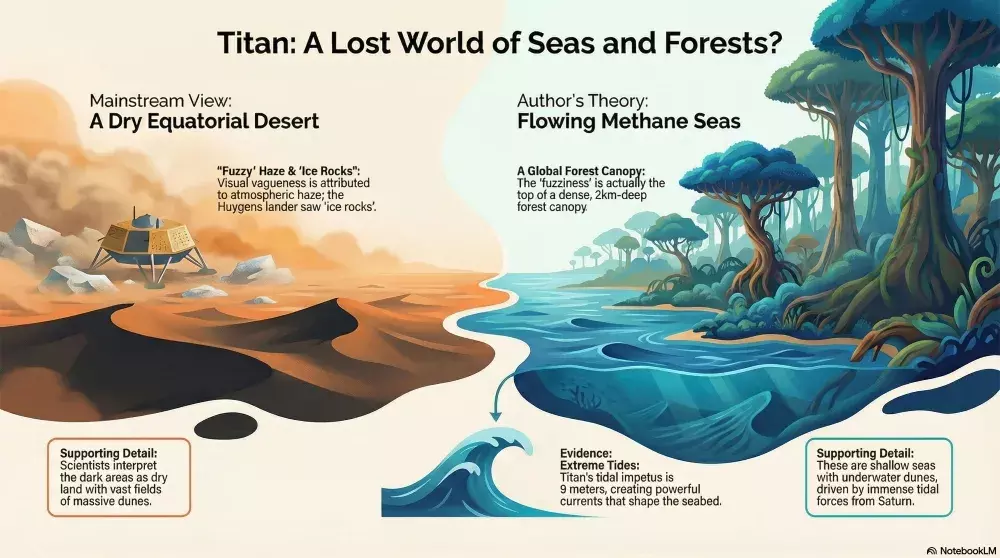
First, he holds that the vast, dark regions at Titan's equator are not dry but are, in fact, shallow seas of liquid methane. This model would explain otherwise baffling data, such as a radio occultation experiment that detected alternating patches of “smooth liquid hydrocarbons” and “very rough terrain.” Carmichael demonstrates that these are simply underwater dunes with crests touching the sea surface. These seas are shaped by immense tidal forces from Titan's elliptical orbit—a tidal impetus of 9 meters, dwarfing Earth’s half a meter. This force drives powerful currents that sculpt the dunes and sediment bars clearly visible in mission images, features that official reports struggle to explain on "dry ground."
Carmichael's second claim would resolve one of Titan's greatest mysteries. Faced with radar data showing the moon's surface to be “so porous” for kilometers deep as to be “ethereal,” one mission scientist proclaimed, “Titan is filled with caves!” Carmichael offers a more logical solution: we are seeing a dense, pole-to-pole forest of gigantic trees. In Titan’s one-seventh gravity, he calculates that trees could reach heights of up to 2,000 meters. This vast canopy explains the moon's visually “fluffy” appearance; the images are not blurry from haze, but are in sharp focus, showing the tops of a forest which naturally lack sharp geological features. In fact, when a high-resolution radar image was shown to a professional cartographer unfamiliar with its origin, the expert unhesitatingly pronounced the scene to be “mixed forest.”
These physical descriptions provide the foundation for a deeper, cosmological understanding of Titan within the framework of The Urantia Book. Carmichael applies specific classifications from Paper 49, "The Inhabited Worlds," to re-organize the known data about this moon.
For example, based on its dense nitrogen atmosphere, Titan would fit the book’s "mid-breather" classification. Its breathing gas is hydrogen, present in a much lower concentration than Urantia's oxygen.
Titan’s extremely low gravity would produce gigantic life forms. This would include not only colossal vegetation but also potential inhabitants of around 10 feet tall, with movements that would be correspondingly "slow and graceful."
Going by The Urantia Book, Titan's frigid environment places it in "life temperature order one of five," whereas Urantia is a warmer "three." This suggests a unique life chemistry that would be explosive at Earth temperatures but perfectly suited for Titan's deep freeze.
The Urantia Book states that, "In your solar system only three planets are at present suited to harbor life" (15:6.15). Students of the book have naturally been interested in identifying these worlds. Carmichael proposes that alongside Urantia, the other two potentially life-bearing worlds are Jupiter's moon Ganymede (as he explained in a previous article) and Saturn's moon Titan.
The Urantia Book reveals that solar systems with three or more inhabited worlds are rare in our local system of Satania. Out of 619 systems, only one has four inhabited planets, and a mere four systems have three. If Titan harbors intelligent life, or is at least suitable for future inhabitation, it would mean our solar system, Monmatia, is "almost unique"—a special and rare cradle for life in this part of the cosmos.
“The Urantia Book left us to identify Ganymede and discover about Titan for ourselves! Once our science catches up on them, it will lend yet more credibility to the book,” says Carmichael.
You can read Craig's Titan essay here.


Comments
By posting, you agree to follow our Community Standards.