

Thursday, May 22 2025
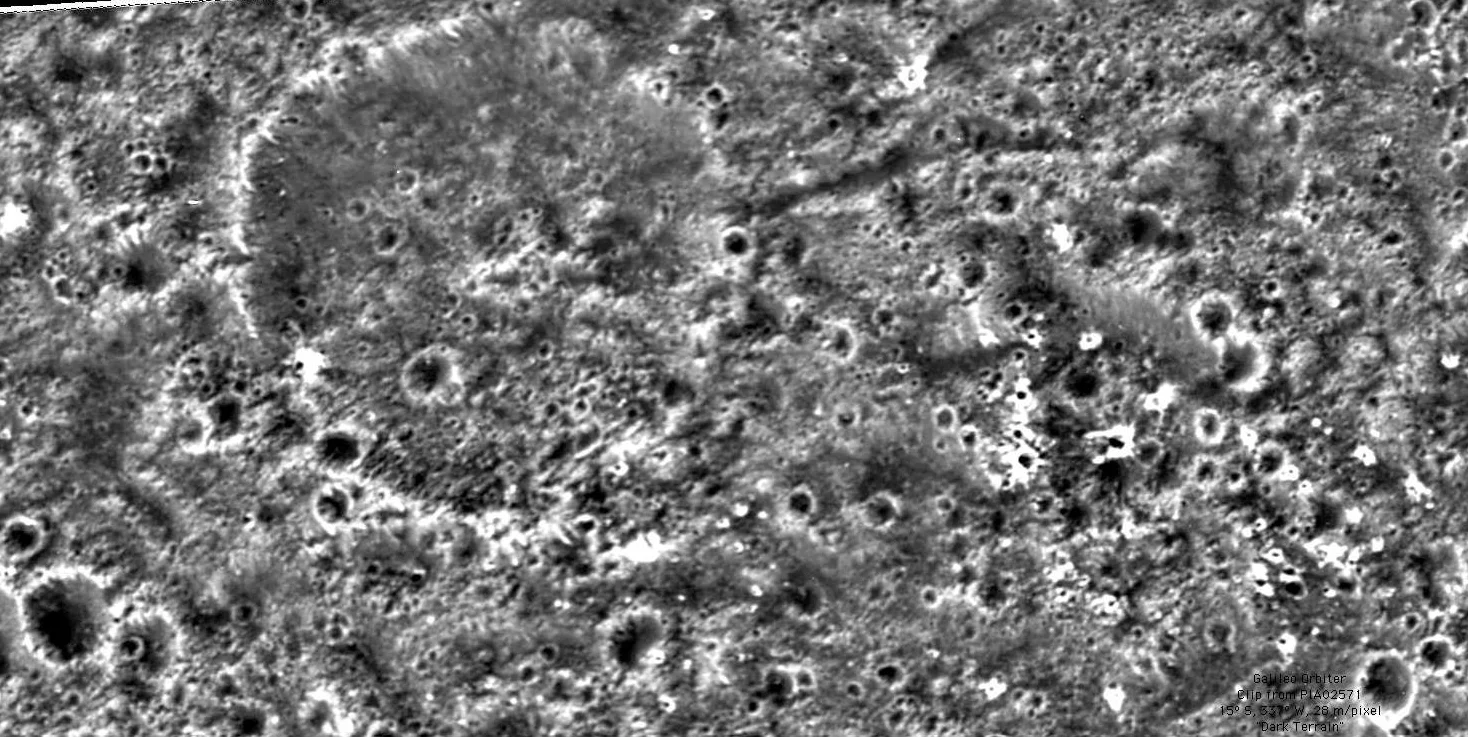
Ganymede is the one "inhabitable size" world (though quite small) in our solar system known to have a magnetic field to deflect high speed, high energy charged particles ("cosmic rays"), which are inimical to life. The grainy monochrome images here show—much less than clearly—that Ganymede is covered with some sort of huge corals.
The images I reference were taken by the Galileo space probe around 30 years ago, but no one figured out what it was they were looking at. The space scientists, "knowing" there could be nothing so interesting as life on Jupiter's airless satellites, were hardly interested in deciphering these puzzling pictures, or in the spectroscopic findings of polycyclic aromatic hydrocarbons—associated only with life, as far as I know—and other puzzling findings like diurnal temperature readings indicating the surface was "fluffy". They hardly looked.
Of course I was far more interested, having read The Urantia Book’s Paper 49, "The Inhabited Worlds", and I followed the Galileo and Cassini probes closely. Paper 49 says there is a world of nonbreathers "in close proximity" to our world (49:3.6). It explains that a nonbreathers' world would be an airless or almost airless world where all the other conditions for some form of human life are met. It also says life on such worlds is "radically different" from that of atmospheric worlds. This can well be believed, and it definitely piqued my interest!
Something that continually amazed me was how the space scientists’ attention was so easily distracted by “bright, shiny objects”—by the volcanoes on Io and by water spewing from "overgrown comet" Enceladus, to the point that the whole missions were diverted from studying what to me were more interesting: the real worlds Titan and Ganymede, both between Mercury and Mars in size. (Perhaps equivalent to sending a probe to Mars and studying its moonoid Phobos instead because of some oddity seen there. A whole early space mission, Ulysses, was completely diverted from study of the sun to Jupiter when it accidently discovered the Io plasma torus, the ring-shaped cloud of ions and electrons surrounding the planet. It went back to Jupiter instead of its planned solar orbit and its main mission was completely wasted.) With Galileo, the entire last and closest set of images from the last Ganymede flyby were lost because the camera shut down at the critical time, damaged by too many passes through the high radiation zone around Io.
After all these annoying "sidetrack" Io flybys, the delay, and then loss of this "main event" photo pass, was a huge disappointment to me. (After that there was only the inglorious end to the mission by diving the Galileo into Jupiter.)
I’m guessing that the mission was finely engineered by celestials to prevent the Urantia public from being confronted with the fact that there are people on Ganymede. The incredible lack of a real color camera among the instruments (Cassini too!... "We're after 'scientific data', not pretty pictures!"), and the failure of the high gain antenna to open, leaving very limited imaging and data transmission capability, were perfect to give us a few low quality, grainy, monochrome images, sufficient to let unobservant space scientists think they had determined the essentials of an inert, uninteresting world without discerning the real surprise, and so ensuring that no further probe would be sent to study Jupiter's moons for decades. If this is true then the failure of the camera on the last Ganymede pass (or two?) was probably an important "tweak". (Carl Sagan would never have let the puzzling images slip through unexplained!)
There is now a new mission being planned by The European Space Agency which is to end up in Ganymede orbit. It is some years off. Things happen. Will it be launched? Will it succeed?
Recently I decided to go over Ganymede again and do a little write-up. In doing that, I looked at some closer-up images (not that there was anything very close up) and realized that there was a sequence of images that all overlapped slightly. In addition to complete coverage of Ganymede from the arctic to the mid latitudes, this meant the small overlapping areas could be viewed in stereo—"3D". (To view stereo images one must "cross their eyes” and "look far away" until the two images merge into one. If they are too far apart one must shrink the image.) This set also looked down obliquely instead of straight down, a great angle for disclosing vertical features.
There was one such area with some puzzling black crossing lines, vertical and diagonal. I had no idea what they were. When I viewed them in stereo, however, the features jumped out at me. The vertical lines were bare trunks or stems, up to around 2000 or even 2500 meters tall, some of which branched into two or three trunks/stems. There were little blobs which I took to be clusters of leaves at the tops of the trunks. (I’ve slightly “colorized” these definitive features to make them easier to see.) I wasn't fazed by the heights. They seemed awfully tall, but Ganymede has only 1/7th of Earth's gravity. And "airless" Ganymede has no winds to blow them over.
At last! There were forms suggestive of vegetation across the whole landscape, but nothing that might convince stodgy space scientists who hadn't read Paper 49. This stereo view seems to me to be definitive. I am completely convinced that the trunks or stems with blobs at the top are exactly what they appear to be: tall thin vertical living things that grew there, even if I don't know their biology.
Having got this far however, the form of the "trees" with leaves only at the top bothered me. They reminded me more of seaweed polyps from the ocean. So too, the trees everywhere looked very strange: visible trunks sticking up into dense foliage at the tops to form an almost impenetrable mass on the tree tops. It was almost like there was “the ground”, vertical “tree trunks” (often in rows), and then more “ground” on top of them, so that the rows of “trees” looked like walls with often solid tops.
Polyps...dense cover...as I stared at the images, stereo and otherwise, I started to think they seemed more like giant corals than trees. A voice in my head affirmed: "They are corals."
That answers a burning question left by The Urantia Book. It says that the advancing races on airless worlds have to make electrical installations to consume or "shunt" micrometeorites, and that they are in extreme (continual) danger when they go outside the protected areas (49:3.3). What do they do before they're technologically advanced enough to make such equipment? The answer must be that they live underneath the corals’ protective canopies.
Corals not under water are strange enough, but I also wondered that if there was no atmospheric gas nor any liquid, how does any life chemistry take place? The atmospheric pressure is zero, but there is a thin "exosphere" of oxygen. I surmise that the plant life on Ganymede uses this oxygen in some manner analogous to the way plant life on Earth uses the seemingly "insignificant" .04% carbon dioxide in Earth's atmosphere for transpiration.
It is slightly puzzling however that Ganymedean plant life has obviously spread to other bodies, notably Callisto and Iapetus, but Callisto is said to have a carbon dioxide exosphere with less free oxygen. Maybe the balance is different because plants are living there but there’s no animal life beyond microbes.
For more details, here are links to my recent articles on Ganymede:
Galileo 35th Anniversary: What NASA Missed on Ganymede
December in Brief: Ganymede
April 25, 2025
Craig Carmichael is an inventor with a rare talent for connecting seemingly disconnected facts to synthesize a "big picture" on various subjects of study. A repeat offender Urantia Book reader since 1982, he ardently followed the Galileo space mission to Jupiter and the major worlds orbiting it, then the Cassini probe to Saturn and Titan. Born in Edmonton, AB, he now resides on a Pacific island, Haida Gwaii, off the BC west coast.


Comments
By posting, you agree to follow our Community Standards.