

Wednesday, July 02 2025
Review by Ken Helsely
If you are not familiar with the “Big Book”, the basic text for Alcoholics Anonymous, it was first published in 1939 as Alcoholics Anonymous: The Story of How More Than One Hundred Men Have Recovered from Alcoholism. It was attributed to the founder of AA, who simply called himself Bill W.
Over the decades that followed, the Big Book, as it became known, has become the primary spiritual text and self-help guide of countless people the world over who are struggling with any kind of addictive behavior. It is used in every twelve-step program still in existence today.
Although I have never been in a twelve-step program myself, I am somewhat familiar with the Big Book as several friends and family members have been or are involved in such programs, so I have read bits and pieces of it, including “Bill’s Story.”
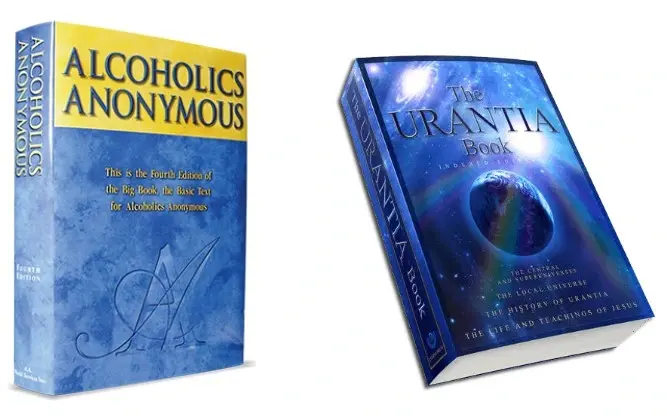
Tom has attempted in this research paper to show direct correlations between some of the preeminent thought leaders of the industrial age, the Big Book, and The Urantia Book, two of the most profound spiritual books to emerge from the early twentieth century. The intent here is to show that the revelators of the Urantia Papers were, and still are, working in many different avenues of expression to project the major themes expressed in The Urantia Book, primarily in Part IV, “The Life and Teachings of Jesus.”
The amount of research that Tom has put into the paper is impressive. He shows 78 direct correlations between a relevant thought leader of the time, the Big Book, and around 270 specific Urantia Book passages.
There are a few redundant uses of passages that he chose to illustrate how an idea expressed in the Big Book or a passage from literature is also reflected in The Urantia Book, but that is to be expected, as the Big Book itself has some repetitive concepts expressed throughout to drive home certain points.
If you are not familiar with the Big Book, you might want to download a PDF version of it before working your way through this research paper. I’m sure that as you read some of the Big Book quotes, they will inevitably lead you to want to know or understand the context in which they were made.

As an example, here is a brief sample of the kinds of correlations Tom makes:
12. “The lesson which these observations convey is, be, and not seem. Let us acquiesce. Let us take our bloated nothingness out of the path of the divine circuits. Let us unlearn our wisdom of the world. Let us lie low in the lord’s power, and learn that truth alone makes rich and great.” - Ralph Waldo Emerson (1803–1882), U.S. essayist, poet, philosopher. Spiritual Laws, Essays, First Series (1841, repr. 1847)
BB - WE AGNOSTICS, p. 45. Lack of power, that was our dilemma. We had to find a power by which we could live, and it had to be a Power greater than ourselves. Obviously. But where and how were we to find this Power?
UB - (34.6.5) The divine Spirit is the source of continual ministry and encouragement to the children of men. Your power and achievement is "according to his mercy, through the renewing of the Spirit.
This detailed research paper certainly confirms the revelator's statement: “We have been instructed to introduce new terms only when the concept to be portrayed finds no terminology in English which can be employed to convey such a new concept partially or even with more or less distortion of meaning.” 0:0.2
One of the common criticisms of the Big Book by mainstream religionists has always been that its concept of deity is too vague, leaving it open to interpretation by anyone from any, or even no preexisting faith system. This meant they didn’t like that it did not adopt their specific idea of the Creator. I dare say this was intentional on the part of the author.
Still, it has left some people who come out of traditional faith systems wondering if they may be violating some tenets of their belief by embracing the Big Book as a spiritual text. But like The Urantia Book, it can and should be used as an enhancement to one’s faith system, not a replacement for it. And for those who had no pre-established faith system, the Big Book has stood as an entry point into a greater search for an understanding of a Higher Power, and I believe it’s fair to say, has probably led many of them to The Urantia Book as an answer to their quest.
I would recommend anyone within the Urantia community who might also be a student of the Big Book, and struggling with the notion of incompatibility, to read this paper. It will undoubtedly calm those fears, and in fact, bolster your faith that the Father uses many avenues to reach his children.
Tom's paper can serve as a useful study resource for students of either the Big Book or The Urantia Book. It may also provide an opportunity for local study groups to temporarily focus on this comparative research paper, which illustrates how the revelators influence the spiritual insight of cultures through literature. I recommend this paper to anyone interested in such an exploration.
Tom Allen's book is available at Amazon.


Comments
By posting, you agree to follow our Community Standards.