
Sunday, November 16 2025
At a high point in the riveting Part IV narrative, Papers 160 and 161 introduce the remarkable figure of Rodan. You may recall what has just occurred: the epic event of the transfiguration of Jesus on Mount Tabor as described in Paper 158. Soon after, in Paper 162, Jesus takes another momentous step: he publicly announces his divinity to large crowds in Jerusalem.
And yet, amidst all this drama, we are confronted with a mysterious new person whose ideas get inserted between these two events. This short essay will mainly focus on the practical side of Rodan’s “lesson plan” for gospel believers offered in Paper 160, but I will start with my speculation on why the revelators make the bold move at this juncture of introducing a foreign philosopher named Rodan.
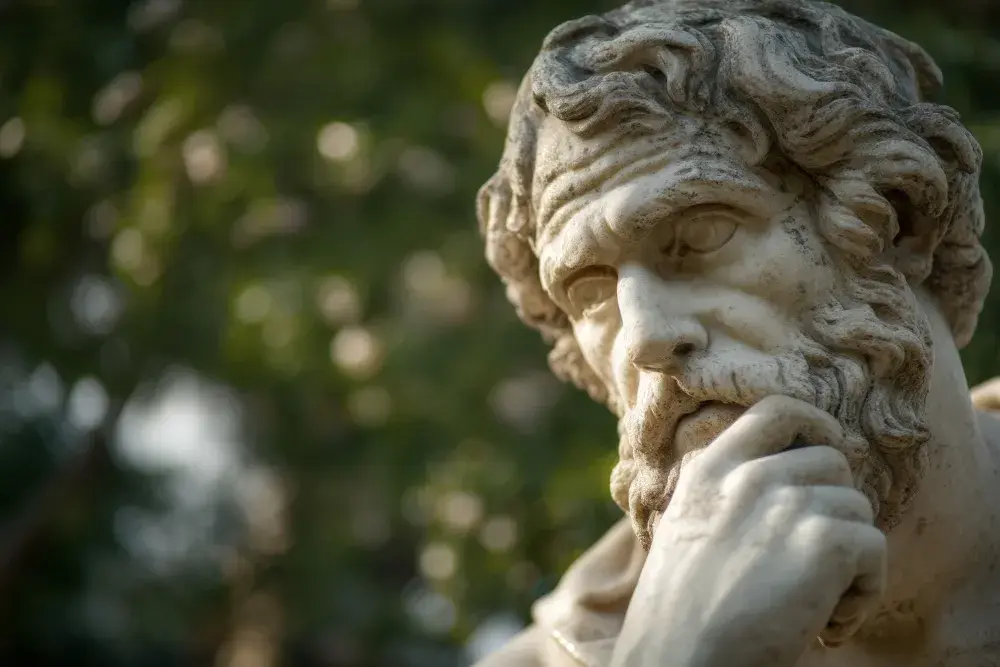
Rodan of Alexandria is a Greek thinker from the ancient world’s leading educational center, a trained philosopher and professional teacher who is focused on the problems of religious living. His story begins as he travels from Egypt to search out and briefly meet with Jesus at the encampment at Magadan. What happens next? We suddenly find him offering extensive teachings, with the permission of the Master, to two of the leading apostles plus a group of disciples. The revelators are clearly intruding here to add a sophisticated thinker’s ideas to the elegant teachings of Jesus—but why do they do it now? I address this question at length in a recent blog entitled Rodan’s Gospel-Infused Philosophy of Living, which you will find at my substack called Union of Souls. I’ll quickly summarize the key points made there.
As I read it, Paper 160 reveals how philosophic ideas about the art of living can harmonize with and amplify our understanding of the new gospel. In essence, the midwayer authors are offering us a philosophic pivot. Rodan’s rich teaching about wise living is adding new depth and more practicality to what is already a revelatory expansion of truth: the enlargement of the New Testament moral teachings that comprises Part IV.
Bear in mind that the New Testament gospels come down to us from a remote and provincial part of the Roman Empire. Part of the revelators’ aim, I think, is to insert someone into the story who is broad-minded, urbane, and cosmopolitan—and not simply a product of the one-sided and sometimes trifling Hebrew religious tradition that is an arcane artifact of the distant past.
In fact, I believe the revelators want us to think more like an ancient Greek philosopher, if you will, when it comes to our interpretation of The Urantia Book’s newly restated gospel.
Rodan is also spot-on for the original gospel teaching of Jesus in all of its splendor. The very thoughtful Rodan contrasts with the sometimes thoughtless Peter, who “unwittingly” (194:0.3) changed the core teachings to a religion about Jesus.
Rodan also takes center stage away from Paul, who invented those novel moral doctrines that come down to us as Pauline Christianity. And while Paul is indeed a fascinating teacher who represents the cream of Hebrew learning, he was also—at least according to Abner—“the clever corrupter of the gospel.”
In conclusion, the heretofore unknown personage called Rodan has been elevated and inserted at Paper 160 for strategic reasons. Remember, friends, scripture is all about interpretation. The revelators want to displace Peter, and especially Paul, from their central positions as the primary interpreters of the gospel, as has been handed down to us in the biblical Christian tradition. Not covered here is Paper 161, which brings forward Rodan’s questions about theology that also far transcend the ideas of the apostles and of Paul; it alludes to the much later writings of the so-called Greek Fathers of the church.
We need Rodan today because we all face unprecedented problems in our modern world and we need all the tools we can get. Given the daunting complexities of the coming century, the revelators want us to interpret the gospel wisely with the help of the figure of Rodan, who stands for the idea of a deep-thinking philosopher who is in love with the teachings of Jesus. In effect, they’re inviting us to not only incorporate Rodan’s gospel-infused philosophy into our daily lives and spiritual practices, but to also continue on in the spirit of Rodan’s inquiry by adding our own creative interpretations of the gospel. So, assuming we agree with that approach, how do we begin to work with Rodan’s teachings?
The simplest answer is that Paper 160 presents what appear to be 15 injunctions, each of which we can put into practice. These include “the greatest of all methods of problem solving”—which is no small matter! Do you remember what that is?
I believe many of these special lessons are critically important, so I have devised a way to measure your Paper 160 progress. You can do it by taking the Rodan self-test—just for fun. I introduced it at my workshop for The Urantia Book Fellowship’s Summer Study Session 2025 in July.
Also for fun, I’d be happy to walk your study group through this workshop on Zoom. Just email me at: byron@rodaninstitute.org.
“The Paper 160 Self-Test,” as I call it, is broken out into four sections that follow the sequence of Rodan’s teachings. Each of these four parts contain specific practices, many of which could (or should) be applied daily. The sections are as follows:
I. Problem-Solving for Successful Living
II. The Art of Living
III. The Balance of Maturity
IV. The Religion of the Ideal
If and when you take the test, you can literally score yourself. The test allows you to give yourself a numerical rating for your current performance on each of the injunctions or lessons—but of course the point of this exercise is to draw you into a better understanding of these teachings!
To aid your memory and support your practice, I formulated each lesson as an “I statement,” almost like an affirmation. In most cases I extracted or paraphrased the often lengthy Rodan discourse that goes with each particular injunction.
For example, I summarize the first Rodan injunction as: I locate and then face problems directly, bravely, and honestly. Here’s some of the original language: “The first step in the solution of any problem is to locate the difficulty, to isolate the problem, and frankly to recognize its nature and gravity.” This item (see it just below) allows you to rate yourself between 1 and 4. (I gave myself a 2.5!)
Another example is Rodan’s “greatest of all methods of problem solving”: the isolation of worshipful meditation. This is boiled down to: I practice worshipful meditation consistently. This one can net you up to 8 points! You can get up to 70 points maximum on the test.
The entire Rodan Self-Test is posted here, but to get you started, please find below the entirety of Section I. Notice that there is a space for writing in your self-rating, and you can total your cumulative score at the end of each section. Again, since this test is a service of the Rodan Institute, I would be happy to present the entire test or parts of it to your study group.
** Score yourself for each item—70 points maximum **
“Successful living is nothing more or less than the art of the mastery of dependable techniques for solving common problems.” (160:1.7)
1. I locate and then face problems directly, bravely, and honestly: (4 pts)___
I am able to locate a difficulty and isolate a problem…and “recognize its nature and gravity” with bravery and honesty, doing so free from prejudice. And concerning my motivation to face these facts fearlessly, I am “driven by an intelligent enthusiasm which borders on religious zeal.”
2. I work to acquire social skills such as tact and tolerance as well as personal charm: (4 pts)___
I have equipped myself with that “wisdom of mind and charm of personality” which enable me to “win the hearty support and co-operation of my fellows”...and I know that I “simply must have tact and tolerance” in order to do so.
3. I practice worshipful meditation consistently: (8 pts)___
I practice the greatest of all methods of problem solving which “I have learned from Jesus, our Master. I refer to that which he so consistently practices, and which he has so faithfully taught us, the isolation of worshipful meditation. In this habit…is to be found the technique, not only of gathering strength and wisdom for the conflicts of living, but also of appropriating the energy for the solution of the higher problems.”
4. I remove prejudice and narrowness through my devotion to a transcendent cause: (2 pts)___
I realize that “prejudice blinds the soul to the recognition of truth, and prejudice can be removed only by the sincere devotion of the soul to the adoration of a cause that is all-embracing and all-inclusive of one’s fellow men. Prejudice is inseparably linked to selfishness. Prejudice can be eliminated only by the abandonment of self-seeking and by substituting therefor the quest of the satisfaction of the service of a cause that is not only greater than self, but one that is even greater than all humanity.”
5. I maintain stability by embracing God as my eternal goal: (2 pts) ___
“Stability of personality can be experienced only by those who have discovered and embraced the living God as the eternal goal of infinite attainment. And thus to transfer one’s goal from time to eternity, from earth to Paradise, from the human to the divine, requires that man shall become regenerated, converted, be born again; that he shall become the re-created child of the divine spirit.”
PART I TOTALS: ___ + ___ + ___ + ___ + ___ = ___ [max 20 pts]


Comments
By posting, you agree to follow our Community Standards.