

Sunday, October 26 2025
July 2025: Robert Sarmast, who was involved in two expeditions to the Eastern Mediterranean in search of the submerged first Garden of Eden, has launched a website that presents tantalizing new scientific evidence of possible human habitation in the area.
The Urantia Book describes the location of the first Garden of Eden as “a long narrow peninsula—almost an island—projecting westward from the eastern shores of the Mediterranean Sea” (73:3.1). The Edenic peninsula eventually sank “in connection with the violent activity of the surrounding volcanoes and the submergence of the Sicilian land bridge to Africa” (73:7.1).
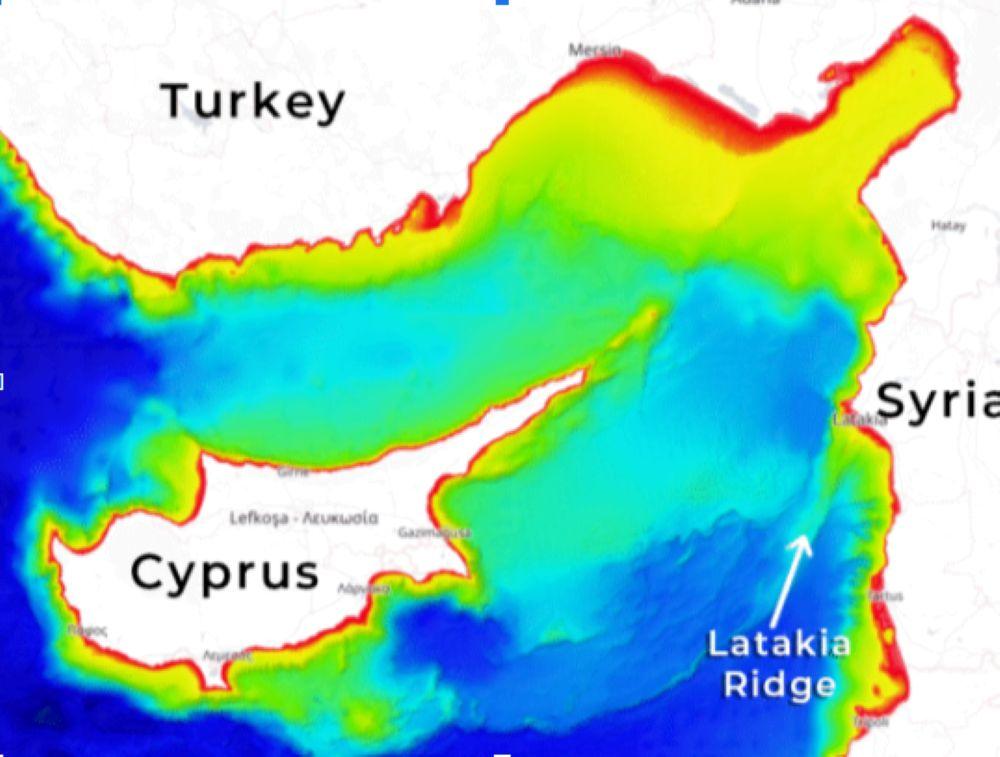
The website, The Sunken Peninsula, details what it calls the world’s first AI-assisted geoarchaeological discovery at the Latakia Ridge, which lies about a third of a mile underwater off the Syrian coast.
The Latakia Ridge is a steep, isolated structure that rises hundreds of meters from the seafloor in a zone prone to tectonic activity. The website raises the possibility that the ridge was above sea level during the Late Pleistocene period and served as a habitable peninsula before being submerged in a secondary Mediterranean flood.
AI-assisted analysis of the Latakia Ridge terrain has revealed anomalous features such as long, straight ridges and trenches, multiple 90-degree intersections, a flat-topped platform with sharp edges, and a moat-like depression surrounding the platform.
“These patterns are statistically improbable, if not geologically inexplicable,” the website explains. “Natural seafloor processes rarely generate rectangular surfaces, cardinal alignments, or intersecting trench networks with such precision.”
The Latakia Ridge Research Institute, under which the website was published, says these discoveries and hypotheses call for urgent scientific scrutiny, field validation, and collaborative investigation. All its evidence—such as bathymetric data, terrain models, and AI-detection workflows—can be downloaded from the site. A full white paper, sent to leading geophysicists, outlines the findings, methods, and statistical analysis.
“We invite scientists, coders, and remote sensing experts to reproduce our results or challenge them using your own tools.”
The next goal is to recover core samples from the summit of Latakia Ridge to determine when it was last above sea level. “This is the critical test. If these samples confirm Late Pleistocene exposure, the implications could reshape our understanding of human prehistory.”
This would be Sarmast’s third archaeological expedition to the area. He was deeply involved in two previous explorations in 2004 and 2006, known as the Eden-Atlantis Project, with Commodore Robert Stanley Bates. In connection with his work in this field, Sarmast wrote Discovery of Atlantis: The Startling Case for the Island of Cyprus (Origin Press 2003, First Source Publications, 2006).


Comments
By posting, you agree to follow our Community Standards.