

Thursday, October 16 2025
The world wide body of Urantia Book readers has often been called a movement. As someone pointed out to me, if our purpose is dissemination of The Urantia Book and its teachings, then it is appropriate to label us as a movement. But when we gather to worship, such as during a conference, I believe we are a community—a spiritual community. So perhaps we can be either, depending on what we are doing. Both functions are important.
Our purpose as a movement is clear: Spread the teachings and make the book available to the world. But what is our purpose as a community?
Intellectual study was where many of us began our relationship with the book, but shouldn’t its teachings, especially those of Jesus, encourage us to move beyond study to something deeper? If we believe the teachings, shouldn’t we consider incorporating them into our lives?
“What an awakening the world would experience if it could only see Jesus as he really lived on earth and know, firsthand, his life-giving teachings! Descriptive words of things beautiful cannot thrill like the sight thereof, neither can creedal words inspire men's souls like the experience of knowing the presence of God. But expectant faith will ever keep the hope-door of man's soul open for the entrance of the eternal spiritual realities of the divine values of the worlds beyond.” (195:9.8)
Prayer and worship are two ways to bring us closer to Jesus and closer to God. Both can be done alone or in a group.
I have often wished that there existed some way to engage in worship with other members of our Urantia Book community. I did worship in a few Christian churches after I had read through the book. While I wasn’t comfortable with some Christian theology, I did feel uplifted. I felt similarly uplifted when I was in a worship service at a Urantia conference. But I wish that worship was a regular practice of our community. The authors point to the importance of worship:
“Worship — the spiritual domain of the reality of religious experience, the personal realization of divine fellowship, the recognition of spirit values, the assurance of eternal survival, the ascent from the status of servants of God to the joy and liberty of the sons of God. This is the highest insight of the cosmic mind, the reverential and worshipful form of the cosmic discrimination.” (16:6.8)
So how can we encourage worship in our community? Should we form a Urantia church? This idea has been tried, but so far as I know, no effort has lasted. The concept of a Urantia Church raises many questions. Do readers and students of the book desire such a church? How would such a church relate to the Christian Church? Would it be a cooperative or a competitive relationship? Would the existence of a Urantia Church enhance or hinder the acceptance of The Urantia Book by Christians?
An important consideration is the future relationship of our community with the Christian Church. The Urantia Book authors seem hopeful that the church will eventually accept the life and teachings of Jesus as given in the book. If that happened, our community might be motivated to worship with Christians. Their theology would have to change, but that seems unlikely in the near future.
However, sometimes amazing changes can occur when the conditions are right. The authors tell us that some great spiritual movement may emerge from the Christian Church. This church does seem to be in a state of crisis, and sometimes crisis precedes significant change. Membership has declined in most denominations though that trend may be leveling off. Perhaps the church will undergo a revival as it has in the past, but that may not affect its theology. So our relationship with the Christian Church may take a long time to change.
However, there are advantages to participating in a Christian church. I did so for a number of years, first in two Methodist churches, then in a United Church of Christ, and finally in a Unity church. The more liberal churches, like the UCC and Unity churches, do not place much emphasis on the atonement and related doctrines, or they ignore them altogether. If you participate in the life of the church beyond attending services, you may find opportunities to mention The Urantia Book to someone who seems open to new ideas. You may even have a chance to make a presentation to a group about the book as I did a few times. Even if no one decides to read it, you will have still offered something of value by presenting a positive view of the book. If a person then hears something negative about the book, they can respond by presenting their positive view learned from you.
Christian worship may not attain the quality that Urantia Book readers wish for, but it is worship available in most areas of our country. And because those in our community share the love of Jesus with Christians, we have a basis for a relationship. I think it would not be a good idea to attend a Christian church with the sole motive of introducing people to the book.
If worship at a Christian Church isn’t appealing, what other options might we want to investigate? How can members of our community worship together? I don’t think we have to form a church. We already gather together in person or on Zoom for discussion. Can we add a sacred time to our discussions?
A group that I’m in, UB Rising, reserves a time at the start of the Zoom meeting for a reading from the book, a time for prayers, and a few minutes for meditation with a video of a candle on screen. It takes less than fifteen minutes, but I think it adds something of value to our time together.
An alternative is to take the time for prayer and meditation before it’s time for discussion, so that those who don’t want to participate can check in when the discussion starts. Or, worship time could follow the discussion period.
In Paper 72, “Government on a Neighboring Planet,” the authors inform us that churches have not appeared in this nation: “Religion is so entirely a family matter among these people that there are no public places devoted exclusively to religious assembly.“ In a way, it’s sad that religion and worship have so often been left mainly to churches in our culture. The family is a community of sorts where worship could take place, and probably does in some homes.
In our larger family/community of Urantia Book readers, could we not make worship a family function? Again, studying the book together has been largely an intellectual pursuit. Why couldn’t it also become a spiritual pursuit by incorporating prayer and worship?
Doing so in Zoom or in-person study groups might be a good first step to introduce worship to Urantia Book reader groups, but could there be a step beyond this, to forming groups devoted to worship?
Do you desire to worship together with other Urantia Book readers? If there was a Zoom group that held periodic worship services, would you be interested in joining it? How would you structure such a service if you were designing it? Should such a group be limited in size?
I am willing to gather ideas and share them through the Mini Messenger or in one of my Facebook groups. If you already have such a group, would you be willing to share details about it? Would you welcome new members? If an idea like this were to spread, an index could be created listing the groups and their contact information.
What would we call a collection of worship groups of Urantia Book readers? A Urantia Church? No! Please, not that! How about something like “Urantia Book Worship Community”? I’m sure an appropriate name could be found if such a collection of worship groups were to emerge.
I believe that worshiping together can add a valuable dimension to our spiritual lives. Jesus had this to say:
“Jesus taught his followers that, when they had made their prayers to the Father, they should remain for a time in silent receptivity to afford the indwelling spirit the better opportunity to speak to the listening soul. The spirit of the Father speaks best to man when the human mind is in an attitude of true worship. We worship God by the aid of the Father's indwelling spirit and by the illumination of the human mind through the ministry of truth. Worship, taught Jesus, makes one increasingly like the being who is worshiped. Worship is a transforming experience whereby the finite gradually approaches and ultimately attains the presence of the Infinite.” (146:2.17)
Come, let us worship together. (Derived from Psalm 95:6-7)
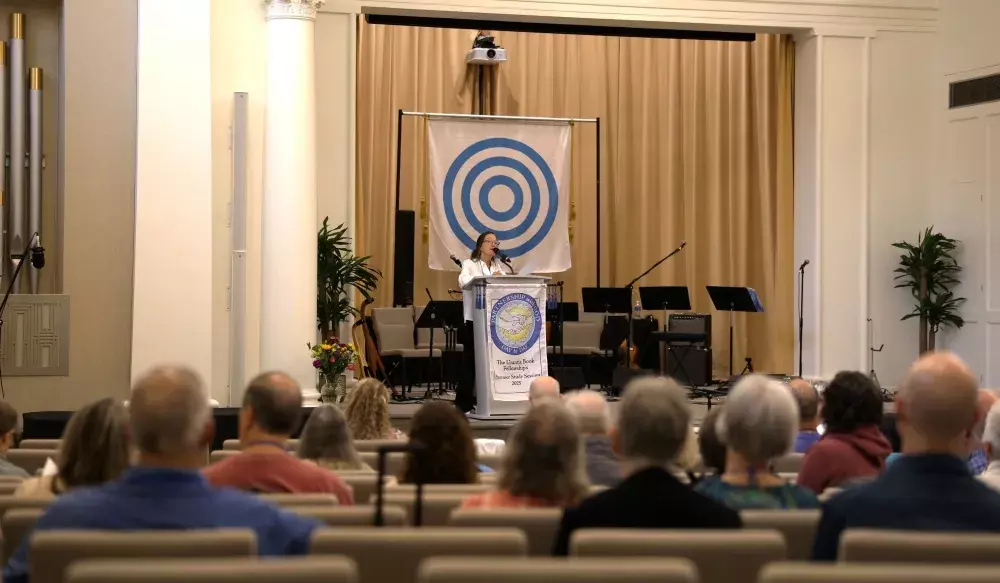
(Picture shows a worship gathering at Summer Study Session 2025)


Comments
By posting, you agree to follow our Community Standards.