
Wednesday, May 07 2025
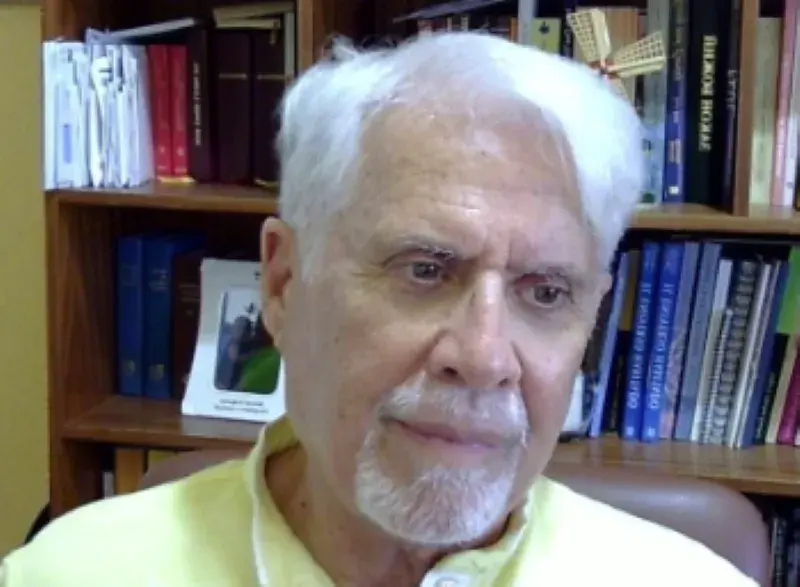
The man behind a translation of The Urantia Book into Spanish, Ángel F. Sanchez Escobar, has published a new secondary work that he describes as a “more readable” translation of Part IV of the book.
El evangelio del reino según Los escritos de Urantia (The gospel of the kingdom according to the Urantia Papers) was released in February 2025. It marks an important contribution to efforts to spread the teachings of Jesus—as retold in The Urantia Book—to the vast Spanish-speaking world.
Part IV, the “Life and Teachings of Jesus”, has already been published, in English, in a number of standalone volumes over the years, from Harry McMullan’s Jesus—A New Revelation to Mo Siegal’s The Untold Story of Jesus.
These books target an audience who may not be comfortable with reading the whole of the 2,000-page revelation but who might be drawn to the comprehensive, sublime, soul-inspiring narrative about Jesus gifted to the world by the revelators.
The Untold Story of Jesus was notable for its high-quality, highly attractive format, reducing the text length from the original Part IV and accompanying it with beautiful art to illustrate important episodes in the life of Jesus.
Ángel too has attempted to make Part IV more accessible to a wider audience in Spanish. But apart from the new title and cover, his approach was different—he focused on language.
His original Spanish translation of The Urantia Book (2021) was published in three volumes in 2021, the last volume being Part IV. But El evangelio del reino is in a different style, he says: “I tried to apply the Spanish narrative techniques (I am a novelist) to make this Part IV more readable.” This approach necessitated the removal, as far as possible, of what he calls the “redundancy inherent in English rhetoric.”
He explains: “English rhetoric is linear while Spanish is digressive. Our language ‘hates’ the repetition of terms and regularly uses synonyms instead, which create digressive sequences of thoughts. Yet, English uses this repetition for lexical cohesion. Thus, unless you consider these and other issues, it is very difficult to translate from English into Spanish without breaking the Spanish rhetoric.”
He provides examples from the book of typical repetition, one of them reproduced below, using capital letters only for demonstration purposes:
“But the audacious BOLDNESS of JESUS in PUBLICLY APPEARING in JERUSALEM overawed HIS ENEMIES; they were not prepared for such a daring challenge. Several times during this month the SANHEDRIN made feeble attempts to place the Master under arrest, but nothing came of these efforts. HIS ENEMIES were so taken aback by JESUS’ unexpected PUBLIC APPEARANCE IN JERUSALEM that they conjectured he must have been PROMISED PROTECTION by the ROMAN authorities. Knowing that PHILIP (Herod Antipas’s brother) was almost a follower of JESUS, the members of the SANHEDRIN speculated that PHILIP had secured for JESUS PROMISES OF PROTECTION against HIS ENEMIES. JESUS had departed from their jurisdiction before they awakened to the realization that they had been mistaken In the belief that his sudden and BOLD APPEARANCE IN JERUSALEM had been due to a secret understanding with THE ROMAN officials.” (162:1.7)
Ángel observes that in a single paragraph, “Jesus” is repeated five times; “appearance”/”appearing”, three; publicly/public, twice; Jerusalem, three times; his enemies, three; Sanhedrin, twice; promised/promises (protection), twice; boldness/bold, twice; Roman, twice, and Philip, twice.
It is not only the repetition of terms he points to but also of phrases or clauses that carry the same meaning: “publicly appearing in Jerusalem”/“public appearance in Jerusalem,” “promised protection”/“promises of protection,” “boldness of Jesus in publicly appearing in Jerusalem”/“bold appearance in Jerusalem."
The new translation does away with much of this sort of repetition, considered redundant in Spanish rhetoric. “The book, especially Part IV, has thousands of lexical repetitious strings that transgress the Spanish language…I just tried, in this new book, to make the language closer to the way we write. I had also tried it in my three volumes, but I was more determined to make those necessary changes in El evangelio. Yet I believe I need to go back and revise again. But at my age I feel tired and will leave that for the next generation.”
Ángel was eminently qualified for this undertaking. His illustrious academic record includes earning master's degrees in Hispanic literature and linguistics, working as a professor of Spanish at Vanderbilt University in Nashville, Tennessee for six years, and earning doctorates from US and Spanish universities in English education and pedagogy, English philology, Spanish literature, as well as in theology.
Among his published papers is one on “Teaching Textual Cohesion,” in which he contrasted the coherence and readability of Swift’s Gulliver’s Travels with the complexity and lack of coherence in Defoe’s Moll Flanders.
He’s a prolific author and publisher too. His Urantia-related books in Spanish include Nature and Attributes of God, The Rebellion of Lucifer: Chronicles of our Planet, Abraham and Melchizedek (A Tortuous Pact between Man and God), The First Garden of Eden: the Tragedy of Adam and Eve, and The Lost Years of Jesus’ Life According to the Urantia Papers.
He has also written several books on Christian Orthodoxy in English such as The Development of the Doctrine of the Trinity, The Development of Orthodox Liturgy, and A Brief History of the Byzantine Church, as well as translations of books on spiritual practice such as The Practice of the Presence of God, a best seller. (See his complete works here.)
He was ordained an Interfaith Minister in New York in 2004, a presbyter in Kiev, Ukraine in 2005, and a consecrated bishop in South Africa in 2007. He has been studying The Urantia Book for nearly three decades.
“The translation of The Urantia Book—I often call it the Urantia Papers—was an enormous responsibility. In contrast to the other Spanish translations available, it was not a choral work, but an individual work, although I received help from many American old readers.
“It took me almost twenty years—I am spending all my life trying to expand this revelation in the Spanish world and hardly trying to make it real in my own life. It was a huge responsibility because to translate a text into the target language you need to understand the concepts of the original one—English—and sincerely, after almost thirty years of studying the revelation, there are too many things my mortal mind still cannot understand.”
He cites two main reasons for re-publishing Part IV separately under a new title: “The unfortunate and defective translations that exist, and the much-read plagiarized Trojan equid which so lamentably misrepresents the gospel of the kingdom.”
Asked to elaborate on the second reason, he says: “That was a veiled criticism to uncover the tergiversation of Jesus’ teachings made by the series of novels Caballos de Troya, a deplorable plagiarism of The Urantia Book. These novels have thousands upon thousands of readers. It is true that many of them became Urantia Book readers, but under this kind of Messiah, J.J. Benitez, the author, has created a kind of sect apart that believes every single word of what he and his novels say.”
Ultimately, deep within Ángel's motivation for republishing Part IV in Spanish lies his pursuit of truth and of a truthful rendering of Jesus’s life and teachings. The gospel proclaimed by the Christian churches for centuries is not that preached by Jesus of Nazareth, he says, hence the imperative of spreading the gospel of the kingdom according to the Urantia Papers. He laments today’s ritualistic and socialized Christianity, which he sees as being in danger of disappearing under the tide of secular materialism.
“Today, the Christian Church is not that brotherhood of dynamic believers whom Jesus commissioned to bring about the spiritual transformation of generations to come. It is based almost exclusively on the personal experience of the Apostle Paul, while the true gospel of the kingdom is based on the personal religious experience of Jesus of Galilee.” A stronger bond is needed, he says, between the Church and the life and unaltered teachings of Jesus as reflected in the Urantia Papers.
“The time is coming to rediscover the true life and teachings of Jesus, the true and primeval pillars of Christianity, so distorted and undermined, and to replace the theological religion about Jesus with the living religion of Jesus.”
We are interested in stories about Urantia Book secondary works. Get in touch: publications@urantiabook.org


Comments
By posting, you agree to follow our Community Standards.