
Sunday, November 09 2025
Christianity is in crisis!
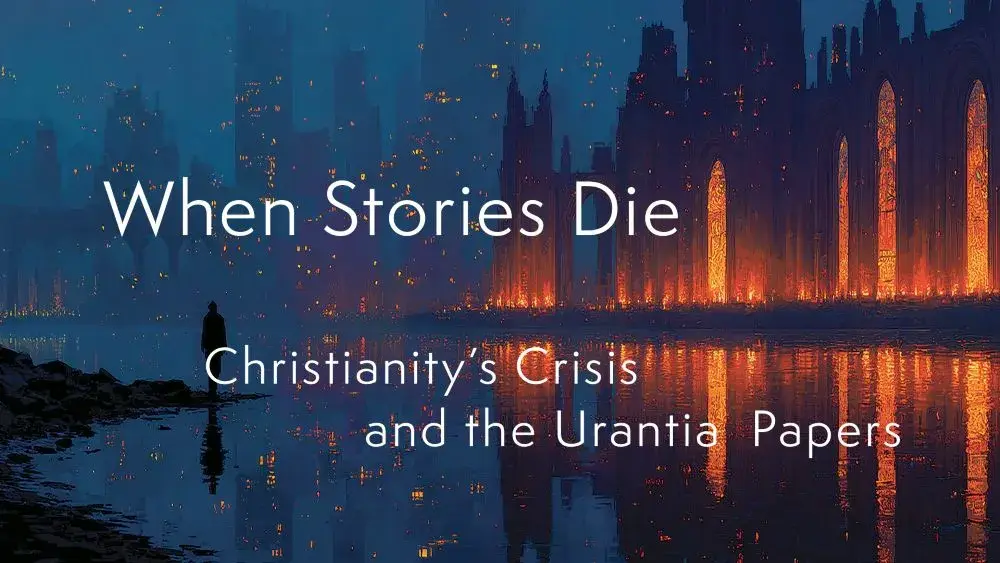
Thus begins the film, When Stories Die: Christianity's Crisis and the Urantia Papers, a 90-minute whirlwind introduction to The Urantia Book.
A favorite story from the book is that of the saber-toothed tiger. (100:4.5) It illustrates the importance of context for the grasp of meanings and values. When an initial conclusion is reconsidered within a widened perspective, a whole new dimension of insight emerges.
When Stories Die provides such a widened perspective for understanding the magnitude and historical significance of the Urantia revelation. It brings to light why dissemination of the book is a critical antidote to civilization's present crisis. And it's the book itself—the entire narrative with its revealed cosmology and historical orientation—that is needed to replace outworn concepts of sacrificial atonement and an afterlife of mystical bliss or eternal punishment.
Christianity's crisis is not spiritual. The Spirit of Truth is alive and well, illuminating the lives of countless men and women around the world. Christianity's crisis is a religious crisis; a crisis of outworn doctrines about the nature of reality; disorientation in the face of expanding concepts of time, space, and evolution. Christianity is in crisis because of the loss of its explanatory stories. The sacrificial rituals of ancient Bedouin herders and the dualism of Persian mystics no longer provide viable explanations for how life works.
When Stories Die chronicles how the Enlightenment, the Scientific Revolution, secularism, and postmodernism have eroded the credibility of Christianity's supportive stories. Without a coherent cosmology, Christianity has become trapped in a twilight zone of existentialism. It is unable to provide a vision of destiny needed to inform wise decision making in the turbulent world of socio-political evolution.
As the credibility of Christianity's story has deteriorated, so has the civilization to which it gave rise. And thus we find ourselves descending ever more deeply into the interregnum described in Paper 195. The Tower of Babel is an apt metaphor depicting what happens when the shared world view constituting a civilization collapses.
But we have an epochal revelation! We have the transcendent story which civilization needs in order to reconstruct itself. And therein lies a problem we all experience—how do we bring the healing balm of the Urantia Papers to an increasingly disoriented world?
In Paper 19, a Divine Counselor of Uversa tells us that the true perspective of any reality problem can be had only by the full and unprejudiced study and correlation of origin, history, and destiny.
When Stories Die is written from this perspective. Its observation of the spiritual repercussions of the fourth epochal revelation shows how religious transformations begin at the grass roots in the lives of ordinary men and women—men and women whose lives become extraordinary as they give voice to the Spirit of Truth.
A "full and unprejudiced study" of The Urantia Book leads to some very specific conclusions about the story which needs to be taken to the world. A divinely given mandate permeates Papers 190 through 193 where the commission to proclaim the kingdom dominates the post-resurrection appearances of Jesus. The gospel of the kingdom is the story which civilization needs to save itself. It's the story which enables the Spirit of Truth to extend its influence farther into the social milieu.
One of the most important things for us to appreciate is that the revelation of the Supreme is a far-reaching elaboration of Jesus' concept of the Father's kingdom. (Take any of his parables and replace the word "kingdom" with "Supreme" and you'll get the picture).
The evolution of the Supreme, illuminated by the life and teachings of Jesus, is the transcendent story which will provide the narrative core of the civilization waiting to emerge in the fifth epoch. This is an expanded vision of the kingdom of heaven which the Master commissioned his followers to reveal to the world: Cosmic citizenship, ascendent life in an eternal universe, participation in the living organism of the Grand Universe—sonship with God. The teachings of Jesus tell us how to navigate the challenging interpersonal waters of Supremacy.
The Urantia Papers reveal the truths which the world needs to know about itself. This, of course, can all be simplified into "The fatherhood of God and the brotherhood of man." But the revelation gives us conceptual resources for unpacking the cosmic depth of this overly used tagline and putting some meat on the bones of kingdom proclamation.
The great hope of When Stories Die is that it will mobilize deeper commitment and wiser strategies for dissemination of the fifth epochal revelation. The film concludes with the triumphantly worshipful music of Kelly Andrew and a quiet beckoning: "All that's needed now are committed messengers."
September, 2025
When Stories Die: Christianity's Crisis and the Urantia Papers was produced by David Kantor for Urantia Book Films, a service project of Rocky Mountain Spiritual Fellowship.


Comments
By posting, you agree to follow our Community Standards.