

Monday, November 17 2025
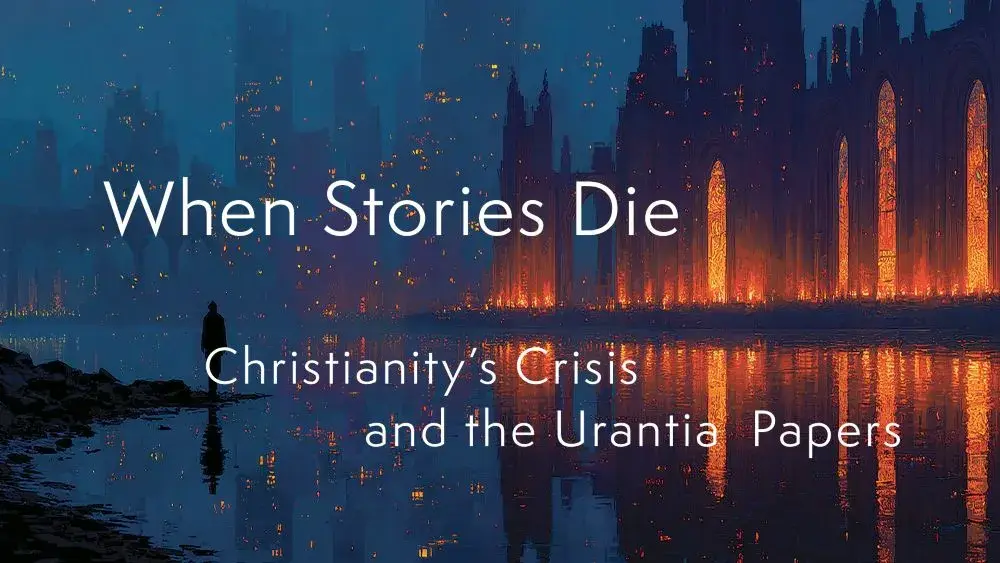
On September 27, 2025, The Urantia Book Fellowship held a well attended online screening of the new movie by filmmaker and veteran Urantia Book student David Kantor, “When Stories Die, Christianity’s Crisis and the Urantia Papers.” This was followed by a Q&A session with David, joined by about 150 people. The discussion revolved around vital issues of dissemination. Here are some highlights from the conversation, edited for brevity and clarity. Fellowship President Sue Seccombe (S.S.) moderated as David (D.K.) fielded questions (Q.) from participants.
S.S. Next year marks 60 years that David has been reading and studying The Urantia Book. Our first question to him is: What was the genesis of this idea? How did you conceive of this film?
D.K. Well, it's been a long project. I found The Urantia Book in 1966, and by 1967 I knew that it was going to dominate my entire adult life. I prayed. I made a commitment to my spiritual benefactors. I said, I'm going to live my life with this revelation, Lord, as much as I can before I die. I'm going to write an introduction to it. Well, I'm getting close to the turning point. The introduction just turned into a film instead of a book, but by around 2000 I thought, I'll do two films. I'll do one on Jesus, which is Reimagining Jesus. It has had a little over 200,000 views in four different languages. Then I would do an introduction about The Urantia Book. That's what this one is.
Q. You did some great work there. I do have to wonder, though, about the title. Is "Crisis of Christianity” an ironic title, because you actually brag about the great accomplishments of all those Christian leaders through time, from Athanasius to Billy Graham. But you didn't mention the crisis in the later part of the 19th century, beginning with the Scofield Bible and Christian Zionism. I'm wondering why.
D.K. The track I tried to follow through the film was the development of spirituality itself, driven by the Spirit of Truth. And the dynamic I see there is that spirituality has grown; it’s alive and well, but the stories that support it have all collapsed. So what we have in Christianity now is essentially existentialism. All of the spirituality is about my life in the present moment and how I get by and how I live my spiritual life. But there's no longer any vision about destiny—apart from Christian nationalism—about how we proceed to create that better world. And The Urantia Book gives us that story. I think the whole issue of the supportive story is critical.
Q. I agree. But how do we dovetail that message for Christians? How do we deliver it to them in a tactful, smooth way so they will accept it?
D.K. That's a really good question, and I don't have a good answer for it. All I can do is try to expose people to this perspective and then listen to what they have to say. It's all an experiment.
Q. Did the Gnostic Gospels have any play in this? Whether it be Thomas, Mary Magdalene, or, you know, the whole list of them. Did that have any bearing whatsoever?
D.K. Yes, that's some of the stuff that got left out [of the film]. I really think it's important for Urantia Book readers to understand something about Gnosticism. In my experience, that is the number one criticism I hear from Christians about The Urantia Book. They say, oh, it's Gnostic. We need to be able to respond to that and tell them why it's not Gnostic. That’s an area of study and learning that anybody trying to propagate the revelation should have some understanding about.
Q. Thank you, David, for this wonderful presentation. The artistic quality is simply amazing from a musical standpoint, and the graphic images are fantastic… One thing that came to my mind is that the divine influence of the Spirit of Truth was active not only within Christianity, but throughout the world, in all the religions of the world at the same time. Thank you very much for this wonderful presentation.
D.K. You're welcome. It's important to keep in mind that all religious transformations begin at the grassroots. They're never top down. So we need to keep that in mind. We are grassroots.
Q. I'm very involved in getting The Urantia Book into libraries in Europe and in South America and Hawaii. Some of the people that I have gotten books to ask me, what do you say when somebody asks you who wrote the book? I don't have a very good answer that I can give to the average public.
D.K. It's a really good question. We've all got that question. We all deal with it. I don't have a pat answer. I try to listen to the person that I'm talking with and get a sense of their orientation before I try to answer that. I can answer it all the way from talking about ethical revelation to a collection of authors. There's a whole range, but it depends on how I'm feeling about the person I'm talking with.
Q. People have an emotional attachment to the Bible. They believe it’s what God wrote down, and I don’t think anyone can change that. How do you not capsize their boat, but help it sail in the right direction?
D.K. I hope I'm doing that with the film. The great line in The Urantia Book is about finding new meanings and facts already well known to mankind, and there's a transition here that we have to make. The Urantia Book talks about Paul, and one of the things he did in the synagogues at the time was to target a fringe of truth seekers. We have that same kind of fringe in Christianity today. We have people who love Jesus, and they like the church and the idea of the church, but they know something is wrong. Part of our challenge is, can we get this to those people? My personal sense is we don't need to reach lots and lots of people. We need to reach one or two people who will then go out and set the world on fire. I'm looking in that fringe.
Q. Thank you David, for that magnificent history of Christianity. There is so much truth in there that I wonder whether the Christian community can stand it. And so, how are we going to bring The Urantia Book to them? Is it going to be enough to say, let’s take a look at this book? I'm wondering how much the Christian community is going to be able to accept your truthful portrayal of our history as Christians from the times of Jesus to 2025, and is that going to make it easier for The Urantia Book to be accepted?
D.K. I don't know. All we can do is experiment, and I appreciate that so many people are trying to do different things. Sooner or later, something will take. We're doing the best we can for as long as we can.
Q. I noticed in the film that preceding the spread was always a magnificent public speaker, or multiple missionaries and monasteries sending out individuals. There was always some big proclamation, some spreading agent that preceded adoption. In South America there was someone who wrote a book about The Urantia Book and it got a giant following. Now it looks like maybe this film is going to be the next thing that precedes our missionary efforts. I don't know if you wrote it with that in mind, but it certainly could serve in that role for this generation.
D.K. Yes, my purpose was to try to stimulate more dissemination, more people committing to disseminating the book.
Q. And a school is next. An ambassador school.
D.K. Well, that's totally outside my domain of ability. We have the Urantia University Institute coming along. They're doing great work. So that's a really good start.
Q. People want to know that God has not left us with a stark, blunt biblical scripture, but that God is living again through each of us. As The Urantia Book says, the world needs to see Jesus living again through the lives of spirit-born mortals like us. If enough leaders and teacher instructors can be brought forward that understand the background history of Christianity, and now perhaps the revelational aspect, then we might even grow that fringe audience you referred to, David.
D.K. Well, the Urantia movement has no shortage of ideas about what ought to be done or what we could do. It all just takes time and money, and it's just slow. We're all full of ideas and it’s a challenge to find one, run with that one idea and get it done. Look at something like The Chosen. It's pretty popular. I think their budget for this last season was 43 million dollars. That’s the kind of thing we're up against. We've got an epochal revelation and the work's being done by people in spare bedrooms and people like Pato [Banton] and Antoinette[Rootsdawtah] running all around the planet trying to make things happen. It's just slow. Everybody's got to do something.
Q. Watching the history that you've presented, we see that there needs to be a movement or individuals that go out there and do something for the revelation that they believe in. Going forward, we have to now step up and do something to bring this revelation to the world. But what I have found is that the biggest resistance to this lies within the Urantia movement. Other Urantians have always told us to slow down, step back, don't rush, don't go out there saying too much. There are a lot of readers with an influential voice within the Urantia movement who rein in the zealous people and hold them back. My question, David, is do you think things have changed? How do we navigate that? How do you envision that happening?
D.K. I agree with you completely. And that was part of my motivation for doing this film, to try to give Urantia book readers a little kick in the butt. It’s a really important question. When you look at religious movements, they're so tangled up in politics and money and people who want to use religion to construct social identities and be political leaders. The bottom line for me is I don't feel I can tell people what to do. I have enough of a challenge trying to figure out what I can do. I can only tell people, pray. If you want to be involved, get involved, tell your spiritual benefactors that you want to be engaged, and pray about it. Do it over a period of time and be sincere. It's important to remember that the work of the kingdom is all voluntary. Be a purple glowing angel, show up in your house, give yourself an assignment…you've got to figure out what to do. That's really all I can say. I'm baffled by the political lethargy of the teaching institutions. And I just wonder if it's because they really aren't supposed to be there.
You know, I think that the angels of the churches who are in charge of this thing for at least the first hundred years want to see it introduced into existing religious institutions, not the evolution of yet another sect or denomination. And I think we're seeing some of that happen. I think that with all of the translations that Urantia Foundation has done, and with work that people like you are doing, it's getting spread around the grassroots globally. I'm hopeful that it can rise and flood the institutions. They're not needed other than to coordinate things and to publish. Publishing books is important, but the whole trend towards building sects and denominations and trying to bring people into our group rather than going into theirs…look, you pulled my trigger, Pato, sorry.
Q. The Urantia Book says we may use these institutions, but we are not supposed to be supplanted by them. So I always encourage people, if you're in a church or if you're with a church, continue with that church until you've totally outgrown it. But don't allow that church to supplant what the revelation is doing for you in your life. Because sometimes Urantia Book readers may be isolated with the book and need that church community. But sometimes they end up hiding the book or pretending that they don't have any relationship to the book. And then the church supplants what they're doing, their integration with the revelation. You have to kind of use the institution as a tool for you to advance the revelation in your own individual, subtle way. But we have to be active. We have to do something. We can't just have the book and sit on it or hide it at home.
D.K. This is the whole issue of the socialization of the revelation. I know that the Fellowship is going through all sorts of internal things right now, trying to figure out how to position itself. How do we facilitate socialization and not build big institutions? I think Alcoholics Anonymous is a great example of how to do things. That's one of the most powerful movements of the 20th century with no superstructure overhead. We need to take seriously how they've operated successfully.
S.S. David has made the link available to show the film for free at your church, in a library, in a small group, in your home, in an AA meeting…whoever will allow you to screen a full-length professional feature film that gives an exhaustive history of Christianity and the Bible, go for it. Take the link and see who will let you play it. Right, David? Free.
D.K. Yes. If I could just put in a plug for the website. Andrea Barnes has just built a new website for Urantia Book Films, which is essentially an archive of outreach ministry materials. UrantiaBookFilms.org. Great outreach materials on that website.
S.S. We can all use whatever fits and whatever works, wherever we are. It won't be the same every day and for every person, but we need to be creative. I'd like to thank all the celestials that were here today, inspiring us and letting us speak with each other and commune for the glory of God, and for all of the inspiration that brought you here and brought David through this project. It's a prayer of gratitude for all of you and for this work and for the future. Thank you, everybody.
Watch David Kantor's film here.
Watch the whole Q&A here.


Comments
By posting, you agree to follow our Community Standards.