

Sunday, November 16 2025
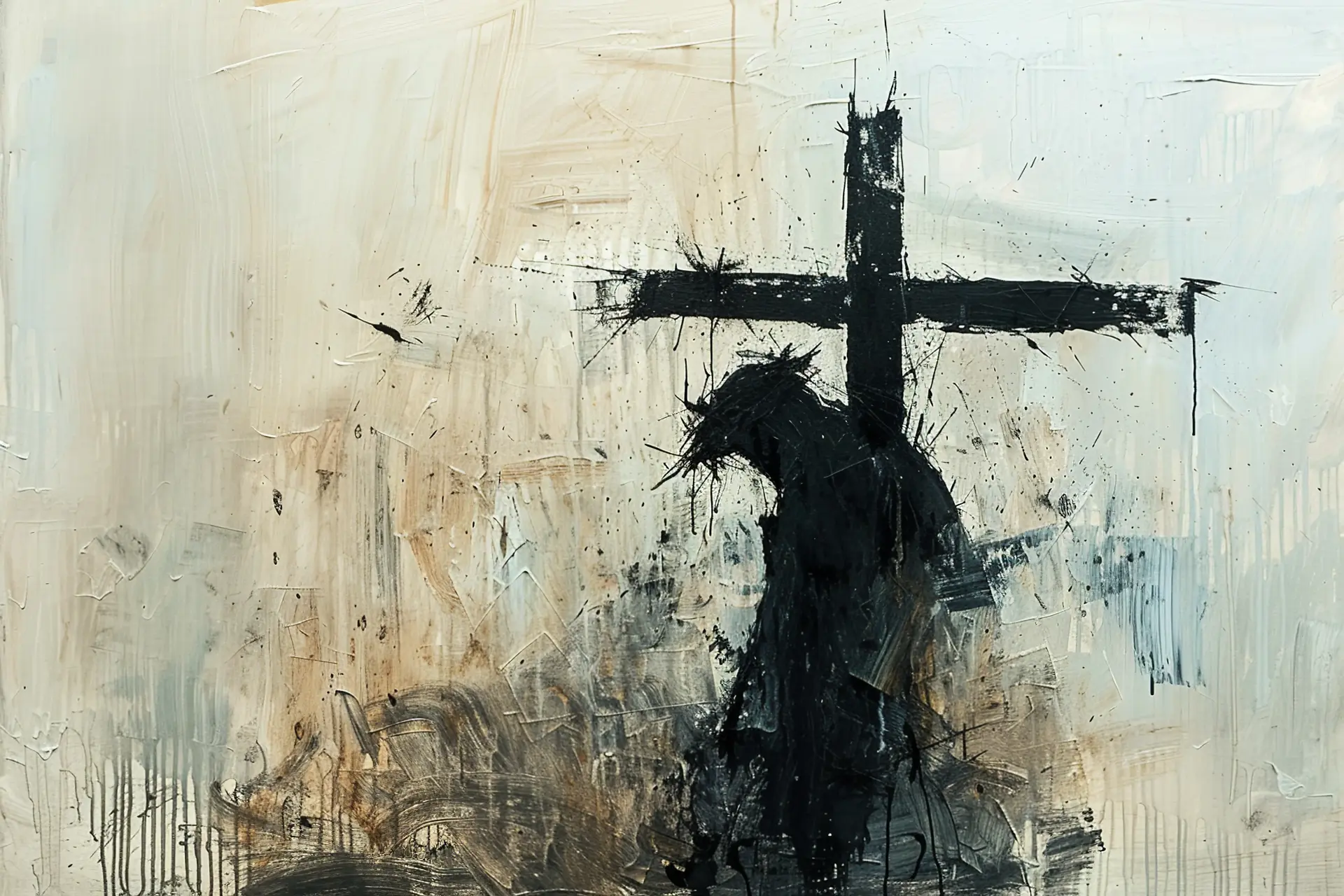
The cross was the dramatic ending of a life dedicated to revealing God’s love for us. Even in the terrible suffering of the cross, God’s love was revealed.
But if Jesus did not die on the cross to satisfy the requirements given in Christian theology, then why did he die on the cross? I think the answers can be found in The Urantia Book. I have tried to bring them forth in this article.
As I pointed out in a previous article (The Fellowship Herald, Summer 2021) there were within Jesus two consciousnesses, Christ Michael and the human Jesus. In this article, if they seem to be speaking or reacting as individuals, I will be referring to them as the divine Jesus or the human Jesus. In most cases the human Jesus is in full harmony with the divine Jesus, so there is no reason to differentiate them. I realize that my interpretation could sometimes be incorrect, but I have tried to limit my differentiation to the cases where it seemed obvious to me as to who was speaking or acting.
I’d like to begin by discussing the Atonement Doctrine, because I believe this will be a major problem for Christians who try to decide whether The Urantia Book really is a revelation or just a book written by some humans. How will the community of Urantia Book readers respond to these questioners?
The atonement doctrine of Christian theology would have us believe that Jesus had to die on the cross so that God could forgive our sins. This doctrine was formalized by Paul of Tarsus, a.k.a. Saint Paul or the Apostle Paul, and formalized by other Christian fathers. But the idea of placating a god or gods is as old as humanity.
The ancients believed that their gods had anger like mortals that could only be satisfied by human sacrifice. Even children were sacrificed. The early Israelites practiced this form of sacrifice, as illustrated by two references in the Old Testament. It was Moses who persuaded them to switch to animal sacrifice. But animal sacrifice continued until the destruction of the temple in Jerusalem. And the idea of atonement made its way into Christian theology in the early stages of this new religion and has persisted ever since, not just in words but in symbols as well. My wife asked me one day whether Jesus as the Lamb of God had anything to do with atonement. I told her that yes, Jesus is God’s sacrificial lamb. But why has this doctrine persisted so long?
To understand its lasting appeal, we need to consider human needs. First, it helps to see what may cause those needs. Christian theology tells us that we are born sinful because we (even as babies) inherited Adam’s sin, known as Original Sin. And the theology tells us that God is offended or sad because of our sin, and his forgiveness can only be had with a sufficiently pure sacrifice. Jesus is pictured as that adequate sacrifice.
A really attractive feature of the doctrine for many is that we just need to believe it to be saved: instant relief for our guilt that was implanted by the theology itself. A free ticket to Heaven that only requires belief in the doctrine.
But where did Jesus teach about atonement? There are only a few quotes of Jesus in the New Testament that might be interpreted by some as supporting the doctrine. Wouldn’t Jesus have spoken more on such an important concept?
The Urantia Book authors strongly reject the atonement doctrine. It is not compatible with the concept of God as love, and they state that love is God’s primary characteristic. But if we reject the doctrine, then why did Jesus have to go to the cross? Or did he have to?
To understand why Jesus went to the cross, we need to start with the idea that he had committed himself to live his life and conduct his ministry by following God’s will, and see how that led him to accept the cross. This quote from The Urantia Book explains why Jesus would accept the cross.
“The Father in heaven desired the bestowal Son to finish his earth career naturally, just as all mortals must finish up their lives on earth and in the flesh. Ordinary men and women cannot expect to have their last hours on earth and the supervening episode of death made easy by a special dispensation. Accordingly, Jesus elected to lay down his life in the flesh in the manner which was in keeping with the outworking of natural events, and he steadfastly refused to extricate himself from the cruel clutches of a wicked conspiracy of inhuman events which swept on with horrible certainty toward his unbelievable humiliation and ignominious death. And every bit of all this astounding manifestation of hatred and this unprecedented demonstration of cruelty was the work of evil men and wicked mortals. God in heaven did not will it, neither did the archenemies of Jesus dictate it, though they did much to insure that unthinking and evil mortals would thus reject the bestowal Son." (183:1.2)
Apparently the divine Jesus knew about how he would die some time before the Mount of Transfiguration, but it was here that he informed the Apostles about the end of his mission. On August 12, AD 29, Jesus said the following to his Apostles:
“In answer to Andrew, Jesus said: ‘My brethren, it is because you have confessed that I am the Son of God that I am constrained to begin to unfold to you the truth about the end of the bestowal of the Son of Man on earth. You insist on clinging to the belief that I am the Messiah, and you will not abandon the idea that the Messiah must sit upon a throne in Jerusalem; wherefore do I persist in telling you that the Son of Man must presently go to Jerusalem, suffer many things, be rejected by the scribes, the elders, and the chief priests, and after all this be killed and raised from the dead. And I speak not a parable to you; I speak the truth to you that you may be prepared for these events when they suddenly come upon us.’” (158:7.3)
Who was asking God if he needed to go through with the terrible ordeal of the cross in the Garden Of Gethsemane? The divine Jesus had seemingly already accepted the cross to end his mission. The authors say that it was the “humanity” of Jesus that was so distraught, but perhaps the divine Jesus suffered because the human Jesus was suffering, and asked the Father, for the human Jesus, about their fate. An angel delivered the Father’s response:
“Among other words spoken to him by the mighty angel was the message that the Father desired his Son to finish his earth bestowal by passing through the creature experience of death just as all mortal creatures must experience material dissolution in passing from the existence of time into the progression of eternity.” (182:3.6)
So apparently the angel confirmed to the human Jesus what the divine Jesus had already committed to, and the human Jesus accepted it.
Words from the cross
One thing Jesus said on the cross has been interpreted by many Christians as Jesus feeling separated from God. The Urantia Book authors explain why he said “My God, my God, why have you forsaken me?”
“Jesus did not for one moment entertain the slightest doubt that he had lived in accordance with the Father’s will; and he never doubted that he was now laying down his life in the flesh in accordance with his Father’s will. He did not feel that the Father had forsaken him; he was merely reciting in his vanishing consciousness many Scriptures, among them this twenty-second Psalm, which begins with ‘My God, my God, why have you forsaken me?’ And this happened to be one of the three passages which were spoken with sufficient clarity to be heard by those standing by.” (187:5.2)
Two other well known quotes from Jesus on the cross regard forgiveness. Jesus showed his love by forgiving the thief on the cross beside him, and even more love when he said: “Father forgive them; they know not what they do.”
Who died on the cross? Jesus of course, but there were two presences in Jesus, the human Jesus and Christ Michael. The authors indicate there is evidence that Christ Michael was awake and working during the time in the tomb. This makes sense: if Creator Sons are eternal, he couldn’t die.
So then, who was resurrected? It seems obvious that Christ Michael would wish to experience the morontia life, which he did in quick sessions. But what of the human Jesus; was he part of the resurrected Jesus? The authors don’t seem sure about this, but in one place they write:
"'We heard him say, ‘Father, into your hands I commend my spirit.’ We do not fully understand the meaning of such a statement inasmuch as his Thought Adjuster had long since been personalized and so maintained an existence apart from Jesus’ mortal being. The Master’s Personalized Adjuster could in no sense be affected by his physical death on the cross. That which Jesus put in the Father’s hands for the time being must have been the spirit counterpart of the Adjuster’s early work in spiritizing the mortal mind so as to provide for the transfer of the transcript of the human experience to the mansion worlds. There must have been some spiritual reality in the experience of Jesus which was analogous to the spirit nature, or soul, of the faith-growing mortals of the spheres. But this is merely our opinion—we do not really know what Jesus commended to his Father.” (188:3.4)
So, the mortal Jesus is gone but the authors suggest that it was his soul that he gave to his Father’s keeping. But did some aspect of the human Jesus form a part of the resurrected Jesus? The authors didn’t make any comments on this, so we’ll have to wait until we reach the mansion worlds and even then, we may never know.
After the suffering Jesus experienced on the cross, the Resurrection is like a bright sunrise after a stormy night. It brought hope to mortals throughout our local universe. It is a phase of Jesus’ mission that deserves its own article. It is enough for now to remember Jesus’s determination to follow the Father’s will and how he showed love and courage on the cross.


Comments
By posting, you agree to follow our Community Standards.