

Thursday, May 08 2025
FAR AWAY on the edge of your Solar System, about 4.6 billion miles from Earth, lies the planet Exantia. It is located on the far edge of the Kuiper Belt and its orbit serves to shepherd the minor space objects into a sharp outer line. The Kuiper Belt, itself, is composed of many minor Solar System objects and dwarf planets such as Orcus, Pluto, Haumea, Quaoar, and Makemake. The Kuiper Belt is similar to the asteroid belt between Jupiter and Mars but is much larger, about 20 times as wide and perhaps 200 times as massive.
Exantia has no gaseous atmosphere, and the mean surface temperature is a cold, negative 400 degrees Fahrenheit. There exists some frozen water that has arrived by way of cometary collisions on the planet's surface. Exantia's location renders it unobservable by current telescopes on the Earth side of the belt.
About 7.5 million years ago, the Life Carriers arrived from the system headquarters of Jerusem and seeded initial life plasm organisms in four underground caves deemed suitable locations for the type of life the Life Carriers had planned and developed in their laboratories specifically for the extreme conditions on Exantia. The Universe Mother Spirit provided the spark of life. Life on this planet is silicon-germanium based—living crystals. These primitive biologic life forms, under the watch care of the Life Carriers, evolved over time into various types of vegetable and animal life.
About two million years ago, these evolving animals reached the human level of will capability. Around 750,000 years ago, the Exantia society of humans was blessed with the arrival of the Planetary Prince and his staff. After considerable genetic, social, and technical development, and about 37,000 years ago, a Material Son and Daughter (their Adam and Eve) arrived from Edentia to further up-step the genetic potential of these early humans and to lead them farther into the flowering of an intelligent, compassionate, and progressive civilization.
The Planetary Prince’s staff worked closely with the Material Son and Daughter's center of world culture to create a powerfully effective system of education and racial uplift. The beneficial discoveries, genetic improvement, rich culture, and scientific developments continue to this day.
Despite this encouraging start, both the Planetary Prince and the Edenic Material Son and Daughter defaulted in the system-wide upheaval and were subsequently relieved of the duties previously entrusted to them. Melchizedek receivers are now in charge of this world.
The poetry, theater, dance, symphonies, visual art, and artistic embellishments, legacies of the Adamic contribution, are of a high and thrilling quality, providing respite and relaxation for the inhabitants on their extreme and challenging sphere. You would find commonalities, much to appreciate, and they have children's books whose strange and entertaining characters are somewhat reminiscent of your Dr. Seuss books.
For many generations, this people continued to live underground due to the incessant bombardment from meteorites—there is no atmosphere to burn up objects as they approach. It required great human effort to carve out increasingly larger interconnecting caverns, first by hand and later with excavating machines, in which to sustain their daily lives and develop the technology to move outdoors. The first buildings constructed above ground required walls composed of twelve interleaving layers of stone, metal, and a substance similar to asbestos. The entrance to these buildings was strictly through underground tunnels as it was always risky to walk outside. But these efforts were only marginally successful as the structures could not withstand the impact of the denser meteorites.
These Exantians eat no food and drink no water. They are dependent on the intake of various octaves of cosmic radiation which they receive mainly through their large eyes. Exantia is so far from the sun that sunlight is negligible, however the space cosmic rays are able to penetrate the rock walls of their caverns and thus are available for sustenance.
Further, the Exantians are wholly dependent on the continuous ministration of a permanent retinue of Master Physical Controllers to convert these cosmic rays into usable physical bodily organ formations (energy transformation to matter) and for heat. Heat regulation and metabolism is controlled by their autonomic nervous systems in liaison with the Master Physical Controllers. The small nose slits are not for breathing atmosphere, but rather for olfactory sense and for sexual reproduction.
These humans are of the three-brain series. The two primary brains are one for high intellectual function and the other for the spiritual counterparting activities with the Thought Adjuster. The third, rudimentary brain, behind the other two, is highly crystalline in structure and has evolved to operate purely physical functions including interfacing with the somewhat intelligent machinery that is at their disposal.
Exantians are also of the three-gland series. These glands, which correspond to the pituitary and pineal glands, render the thought processes of these humans somewhat more spiritual, ethical, and worshipful than Urantians (that being the name of your planet as it is known in the planetary federation.) The Exantians have no excretory organs. The mouth is ordinarily sealed and opens only for the birth of offspring.
There is no auditory speech as no atmosphere exists to carry soundwaves. Communication is telepathic in the sense that a small saccule connected to the auditory cortex within the skull is able to vibrate upon receiving electromagnetic speech emanations from another person in proximity, extending to a maximum distance of about five miles. Music appreciation, at a high level, is experienced bodily from directly sensed physical vibrations and light, not through sound waves as known on Earth, as there is no air to carry the vibrations from their musical instruments.
The most important element for the Exantians’ civilizational growth was a technology to deflect or destroy incoming meteors. They envisioned the installation of high energy plasma fields about ten miles above the planet's surface, positioned above areas projected for surface inhabitation and buildings. This innovation would inaugurate the above-ground planetary era.
But the first order of business was to develop flying craft capable to emplace and service the meteor-deflecting, plasma field machinery. Just like your earth scientists, they had to develop considerable engineering, step by step, in order to fly, but with no atmosphere! In the Exantia laboratories with the aid of the Material Son and Daughter, they developed strength materials of unidirectional crystals, designed laser light and fiber optic conductors and transistors, and they utilized an energy source not yet discovered on Urantia.
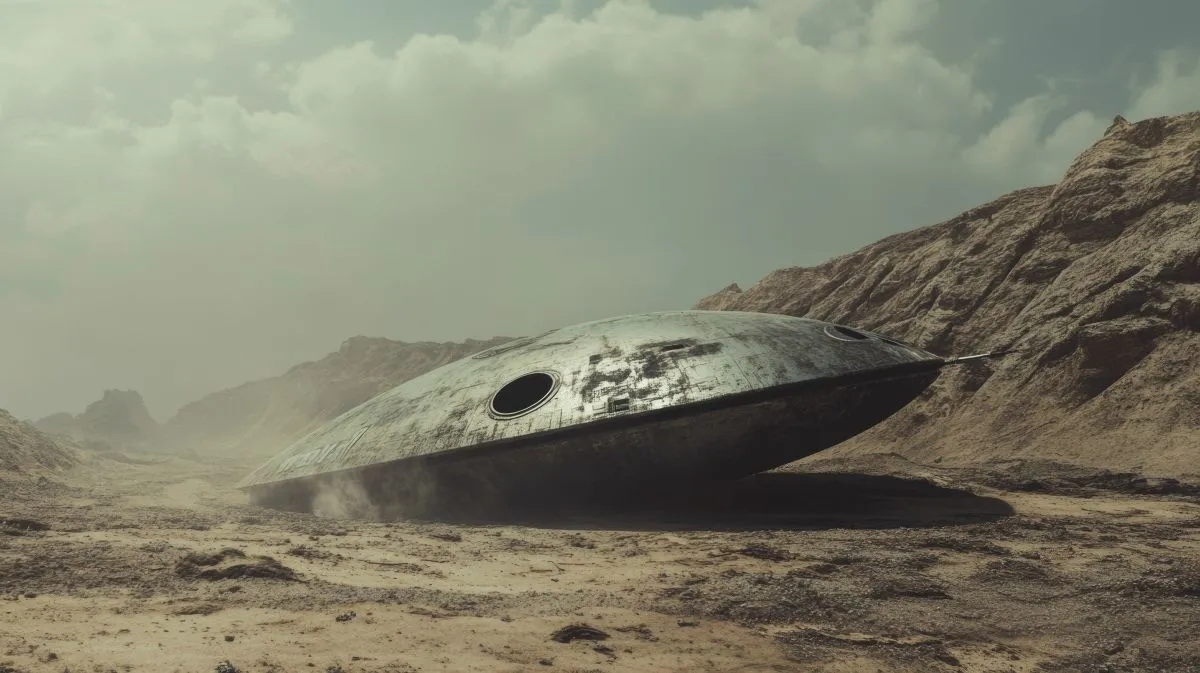
Their effort culminated in the advanced design of a disc-shaped craft. At cruising speed it is oriented vertically. The craft generates a high energy plasma field in the direction of travel that effectively reduces resistance. The opposite, or back side of the craft, is fitted with many quadrillions of tiny, transistor-like components. Each of these operates microscopically like a three-ringed gyroscope to produce gravity-resistant effects through the principle of equal force presence. (See The Urantia Book, 9:3.3)
These same design concepts, utilized for flying passenger craft, were also employed for the stationary orbit autonomous machines (SOAM) that deflect meteors and space debris. One such machine can protect about 12 square miles of planetary surface area. It was cause for great jubilation when the first deflecting drone was successfully put into service at ten miles high.
There were three colored races on the planet, but these colors long ago amalgamated into a composite olive-grey. The Exantians share one language and one religion, the worship of the First Source and Center. Life expectancy is about 500 years. Average height is about four feet, as Exantia’s gravity is greater than Earth's.
Before his betrayal, your Planetary Prince, Caligastia, kept in close touch with Exantia's Planetary Prince. On occasion, he asked for help with meteorite protection for Dalamatia and other populated areas, that being the expertise of the Exantians. Sadly, during the Lucifer rebellion, both Caligastia and Exantia's planetary prince joined the insurrection. Exantia's chief of the Reserve Corps of Destiny, to her credit, vigorously lodged her complaint against this betrayal of Exantia and its peoples.
TWO engineers, a man and a woman named Enkion and Ninhursa, have volunteered for Urantia observation duty.
Exantians have been visiting Urantia since the days of Caligastia's arrival, and they have developed a fondness for the people and the culture of Earth. These two humanoid observers, a “young” 220 years of age, are fully trained and experienced pilots, engineers, and social scientists. Since Michael’s ascension, visitors to Urantia come under the provisional direction of that planet’s Resident Governor General. Although the inhabitants of these two planets differ greatly, their paths follow similar, evolutionary milestones.
The civilization of Exantia initially progressed along normal lines, receiving its full complement of 50,000 midway creatures at the designated time. Some were lost in the rebellion, but the loss was not as great as on Earth. In many useful ways, these permanent citizens of Exantia assist their human cousins to maintain civilizational equilibrium.
Since the time of the grave loss of many of Urantia's midwayers, the councils of Exantia have kindly loaned their midwayers’ services to Urantia, after your world lost so many of its own midwayers to the system-wide rebellion. A total of 1,200 Exantia midwayers, in 10 rotating groups of 120 individuals, are on loan to Urantia for 80-year terms per group. These helpers serve as adjuncts to the United Midwayers of Urantia who value their counterparts for the generosity, experience, and personal touch they bring. This is all deemed most fortuitous.
These Exantia midwayers are transported to and from Urantia in craft with a standard crew of four engineers. However, today's routine mission of Enkion and Ninhursa plus two associates are not transporting, but are rather on an observational mission, largely to check on the progress and welfare of Exantians stationed on Urantia, human or midwayer.
On the day of departure for this routine mission by Enkion and Ninhursa and their two associates, the four are sent off with well wishes by their commander, other staff, and family. Before entering the craft the commander places a ring, a band on each head. The purpose of the ring is to control the craft by relaying the control thoughts of the pilot's crystalline brain (one of three brains) to and from every part of the craft. There are no control surfaces, buttons, or gauges anywhere in the craft. The craft would be called an intelligent machine, and the physical control brain of the pilots would be considered on the order of a supercomputer in common parlance.
With all the safety and performance checks completed, the Exantian crew prepare to leave their planet behind. As the disc rises, each sends a more intimate goodbye to their loved ones. The ship lifts easily to 12 miles, above the plasma drone shields, and rotates vertically with the forward, or top side of the craft, pointed toward the center of the solar system. The abundance of Master Physical Controllers on the planet makes it possible for them to monitor initial acceleration, and a group of seven encircles the disc.
The high energy plasma bubble surrounding the craft and the gravity-resistant components in the hull render the vehicle immune from the effects of acceleration and deceleration. The disc can turn at oblique, right, and even acute angles instantly, with no feeling of compression on the part of the occupants and no impact on the craft structure itself, even at high speeds. The pilots can under certain conditions modulate the plasma field causing light waves to pass around the ship, thereby cloaking the vehicle from vision, if so desired.
The craft begins acceleration and quickly reaches its cruising speed of three-quarters the speed of light. Technically, it takes 6.2 Earth hours travel time to reach Urantia, but due to time compression at that speed, the duration seems much shorter to the pilots and crew.
The craft reached the skies above Phoenix, Arizona on July 7, 1947 (as reported in the Arizona Republic newspaper, with photographs), slowed to make some observations, and continued east reaching New Mexico on July 8. Being shortly after World War II, new generation high-powered radar equipment came available and had been placed around the country, including at the air base south of Roswell, New Mexico, USA.
Unfortunately, the Exantian craft was not designed or equipped for these (to them) peculiar new electronic wavelengths previously unused on Exantia and not encountered even in space travel. The focused, high-energy beams of the radar emitted pulsed radiation on the order of a destructive localized EMP or electromagnetic pulse. The crew, like all others before them, had been strictly instructed to make no contact with the earth inhabitants. But sadly, the craft's navigation became disrupted and the disc crashed in the desert outside of Roswell, New Mexico. Enkion and Ninhursa of Exantia and one other of the crew survived.
The rest, as they say, is history.
"You would be more than interested in the planetary conduct of this type of mortal [nonbreathers] because such a race of beings inhabits a sphere in close proximity to Urantia.” (49:3.6)
Joshua J. Wilson is an educator, musician, pastoral counselor, and essayist who writes on historical and scientific subjects harmonizing science, philosophy, and spirituality. He holds a bachelor’s degree in Business Administration and Decision Information Systems, specializing in Human Behavior in Organizations, and certificates in Not-for-Profit Management and Active Parenting Instruction. Hobbies include camping and hiking. Email: musical@cox.net


Comments
By posting, you agree to follow our Community Standards.